
Aberdeen: granite streets, harbour views, and an unexpectedly perfect day out with GPSmyCity

You know when you arrive somewhere with a neat little idea in your head of what it will be like… and then it quietly shifts your expectations in the nicest possible way? That was Aberdeen for us.
I’ll be honest — with its fishing heritage and oil industry reputation, it’s not obviously a tourist destination. And yet we were genuinely surprised to learn that it is. Cruise ships do dock here, and after spending a couple of days wandering, eating and properly exploring, I can completely see why. There’s more than enough to fill a visit in a way that feels interesting, relaxed and — importantly — a little bit different.
Dinner at The Silver Darling (with a side of harbour theatre)
We booked dinner at The Silver Darling, set right at the edge of the harbour in a former Customs House, and one of those places where the setting does at least half the work for you - I didn't think to ask for a window seat, which in retrospect I wished that I had done so. If you don't know what a Silver Darling is (I didn't) it's a nickname for the common herring.

Big windows look straight out onto the water, and it’s one of those rare dining rooms where you genuinely feel in the landscape rather than just looking at it. Partway through dinner, a large ship glided right past the window to dock — close enough to feel almost part of the experience. Honestly, where else does that happen?
There are lots of lovely quirky touches to the décor which all add to the overall experience. I was rather tickled by the loo signs!
The menu leans exactly where you want it to here: Scottish produce, beautifully handled, with seafood very much taking centre stage.
What we ate
Top: Cullen Skink, Monkfish. Bottom: Rock Turbot and Fish Pie
Alex started with the classic Cullen Skink, a Scottish dish to rival any chowder. I chose the special of the day for my main — rock turbot, and it came with one of those quietly revealing explanations you love in good restaurants. It’s not actually turbot at all, but a fish that feeds on shellfish, and that diet completely shapes the flavour. The result was rich, slightly sweet and almost shellfish-like — deeply savoury and entirely convincing in its own right.
Alex had the fish pie, which he immediately declared “the best ever” — high praise, but completely justified. Properly generous, comforting and just elevated enough to feel like a treat.
Our friend ordered a monkfish dish, which disappeared with suspicious speed and a lot of approving noises.
It was one of those meals where everything lands exactly as you want it to — confident, thoughtful, and quietly memorable.
The next morning: butteries for breakfast

The following morning, we tried butteries (or rowies) for the first time — and if you’re in Aberdeen, you absolutely have to.
They’re a proper local speciality: somewhere between a roll and a croissant, but flatter, saltier, and altogether more serious. Flaky, dense, slightly crisp on the outside and soft within, they feel like they were designed for cold mornings and strong tea.
And in a way, they were. Butteries are closely tied to Aberdeen’s fishing heritage and are widely believed to have been created for fishermen heading out to sea — the high fat and salt content meant they would keep for longer and provide a quick, energy-rich meal during long trips.
It’s one of those foods that makes immediate sense once you know the story.
Exploring Old Aberdeen (the next day) with GPSmyCity
We saved our exploring for the next day, using the GPSmyCity app again for a self-guided walk around Old Aberdeen.
As before, it worked brilliantly — clear, easy to follow, and just enough detail to bring each stop to life without turning it into homework. We’re also increasingly impressed with the way the app allows for updates and contributions, which keeps the content feeling fresh rather than fixed in time.
Old Aberdeen itself feels like a completely different place — quieter, more reflective, and steeped in history from its days as a separate burgh.
Highlights from the walk
Powis Gates

Ornate, slightly theatrical, and an unexpected start — these turreted gates feel almost storybook-like and mark the edge of the university area. Built in 1833–34 as the grand entrance to Powis House, they were designed by architect Alexander Fraser for the Powis estate, then owned by the Leslie family. The twin cylindrical towers, topped with conical roofs, golden orbs and crescent finials, deliberately echo the look of Turkish-style minarets, giving them an almost theatrical, slightly fantasy-like quality that contrasts sharply with the surrounding granite architecture of Aberdeen.
Originally, they marked a private world — an estate that had evolved from 18th-century landholdings linked closely to the university and its academics — before gradually becoming absorbed into the expanding city as the surrounding land was sold off and redeveloped in the 20th century.
But like many 19th-century statements of wealth, the gates also carry a more complicated story. They were constructed at the time of the Slavery Abolition Act (1833), and there is strong evidence that the funds used came from compensation paid to the Leslie family for the loss of enslaved labour on their Jamaican plantations. That connection has prompted more recent reflection, including the installation of interpretation acknowledging this history. The heraldry on the structure itself has also been debated, with some interpreting figures on the coat of arms as representations linked to this past.
Today, the Powis Gates sit within the University of Aberdeen’s campus, carefully restored and unmistakably eye-catching — part romantic folly, part historical marker. They’re beautiful, certainly, but they’re also a reminder that even the most decorative features of a place can carry deeper, more complex stories if you pause long enough to look beyond the surface.
King’s College Chapel
King’s College Chapel is one of those buildings that quietly anchors everything around it — once you’ve seen its crown tower, you start to spot it everywhere. Founded as part of King’s College by Bishop William Elphinstone in the late 15th century, the chapel was consecrated in 1509 and forms part of the University of Aberdeen, itself established in 1495.

The architecture is wonderfully distinctive: the crown tower, a rare example of a Scottish imperial crown design, was intended to symbolise both royal authority and the aspirations of the fledgling university. Inside, the chapel reflects centuries of change. It began as a richly Catholic space, but like so many Scottish religious buildings, it was reshaped by the Reformation of 1560, which stripped away much of its original decoration and altered its role. Despite this, an ongoing sense of continuity remains — it has been in almost constant use for worship and university ceremonies for over five hundred years.
There’s something about the scale of it that feels both grand and personal at the same time. Perhaps it’s because, alongside the weight of history and architecture, it still functions as a living space — used for graduations, services, and moments that matter in people’s lives. That was certainly the case for us: standing there, hearing that our friend had been a bridesmaid here in her early 20s, gave it a completely different dimension. It shifted from being simply a beautiful historic building to somewhere layered with real memories — and that, more than anything, is what makes it linger.
Old Town House

The Old Town House is one of those deceptively simple buildings that rewards a second glance. Built in 1788–89 in an elegant Georgian style, it served as the administrative heart of Old Aberdeen when it was still an independent burgh, a reminder that this quiet, almost village-like area once had its own civic identity and governance. Its symmetry and pale granite give it a calm, ordered presence, and it’s easy to imagine it at the centre of daily life — council meetings, local decisions, and all the small negotiations that shape a place over time. When Old Aberdeen was formally absorbed into the wider city in the late 19th century, its official role faded, but the building itself remained part of the fabric of the area.
Today, as the King’s Museum, it has taken on a more reflective function, housing exhibitions that explore the history of the university and the surrounding area. There’s something rather fitting about that transition — from civic decision-making to storytelling — and it adds another quiet layer to the walk. It’s not the most dramatic stop, but it’s one of those places that deepens your understanding of Old Aberdeen as somewhere that was once self-contained and self-governing, rather than just a picturesque extension of the modern city.
Cruickshank Botanic Garden
The Cruickshank Botanic Garden is both a gift and a legacy. It was established in 1898 when Anne Cruickshank donated land to the University of Aberdeen in memory of her brother, Dr Alexander Cruickshank, a local physician, with the intention that it should serve both science and the public. From the outset, the purpose of the garden was clear: to support the study of plants, advance scientific understanding, and provide a place that people could access freely and enjoy. That dual role still defines it today. Over time, it has grown into an 11‑acre space that combines structured planting — herbaceous borders, sunken and rose gardens, and an arboretum — with a broader educational mission, supporting university teaching, research and conservation work. There’s something quietly lovely about that original intention: not just a decorative garden, but a working, learning landscape designed to deepen people’s understanding of the natural world. And yet, as a visitor, what you experience first is much simpler — a calm, carefully composed green space that feels both purposeful and genuinely restorative
St Machar’s Cathedral

St Machar’s Cathedral carries layers of history that stretch far beyond what you first see. Tradition places a Christian site here as early as around 580, founded by St Machar himself, a companion of St Columba, who is said to have chosen the spot because the bend in the nearby River Don resembled a bishop’s staff.
The documented history begins later, in the 12th century, when King David I moved the bishopric to Aberdeen and a Norman cathedral was built on the site around 1131. From there, the story becomes one of continual building, destruction and rebuilding, shaped by war and changing religious life. The cathedral suffered damage during the Wars of Independence, including the sack of Aberdeen in 1336, before being largely rebuilt in the late 14th and 15th centuries, giving us much of the structure visible today.

Influential bishops left their mark — particularly William Elphinstone, founder of the University of Aberdeen, and Gavin Dunbar, who commissioned the distinctive heraldic ceiling in the early 1500s. The Reformation in 1560 brought major change, stripping parts of the building and ending its Catholic life, and then a dramatic moment in 1688 saw the central tower collapse during a storm, destroying much of the choir and transepts. What remains today is the nave — still in use — which gives the cathedral its slightly unusual, truncated feel. It’s this layered history, from early Christian legend through medieval ambition to partial ruin, that gives St Machar’s its quiet gravity — less a single building, more a record of everything that has happened to it over the centuries.
Seaton Park

And then everything opens out. Wide lawns, river views and space to breathe. One detail we particularly loved was the man-made mound — a gentle grassy rise that looks completely natural until you realise it was deliberately landscaped. It blends so seamlessly into the park that it feels as though it’s always been there, part of the scenery rather than an addition to it. Tucked quietly into the edge of Seaton Park, the grassy mound that at first glance looks like part of the park’s gentle landscaping is in fact one of the area’s most intriguing archaeological features. Known as Mote Hill (or the Tillydrone mound), it was once thought to be a medieval motte — the kind of earthwork you would expect to find beneath a timber castle — but excavations in the early 2000s revealed something much older and far more interesting. Beneath its later shaping lies evidence of a prehistoric burial cairn, with activity on the site stretching back potentially to the Bronze Age, before being reused in the 2nd century AD as a small enclosed Iron Age settlement, complete with timber palisade and structures on its flattened top. The mound as you see it today has also been reshaped and heightened in later periods, which is why it sits so neatly in the landscape, but at its core it is a layered fragment of ancient life — part burial site, part defensive settlement. It’s one of those places where history isn’t signposted in obvious ways, but once you know, it quietly transforms a simple walk into something much deeper.
Wallace Tower

The Wallace Tower is one of those gloriously improbable pieces of heritage that feels almost too neat a story to be true. Originally built in the early 17th century in the centre of Aberdeen, it once stood as part of a townhouse associated with the powerful Menzies (or Menzeis) family, reflecting a time when fortified urban homes still had something of a defensive edge. Its survival, however, is down to a very 20th‑century twist: in the 1960s, the tower was carefully dismantled and moved stone by stone to its current position in Seaton Park to make way for city-centre redevelopment. What you see today is therefore both original and relocated — a slightly displaced piece of the past, rebuilt with remarkable care. It’s a fascinating example of how heritage can be preserved in a pragmatic, almost improvised way, and while it no longer occupies its original setting, it arguably gains something from its quieter parkland surroundings, where you can properly take in its thick stone walls, narrow windows and sense of age without traffic rushing past. It stands as a reminder that history isn’t always preserved in situ — sometimes it has to adapt to survive. We stopped here for a cup of tea and slice of cake to give our legs a little rest.
Brig o’ Balgownie
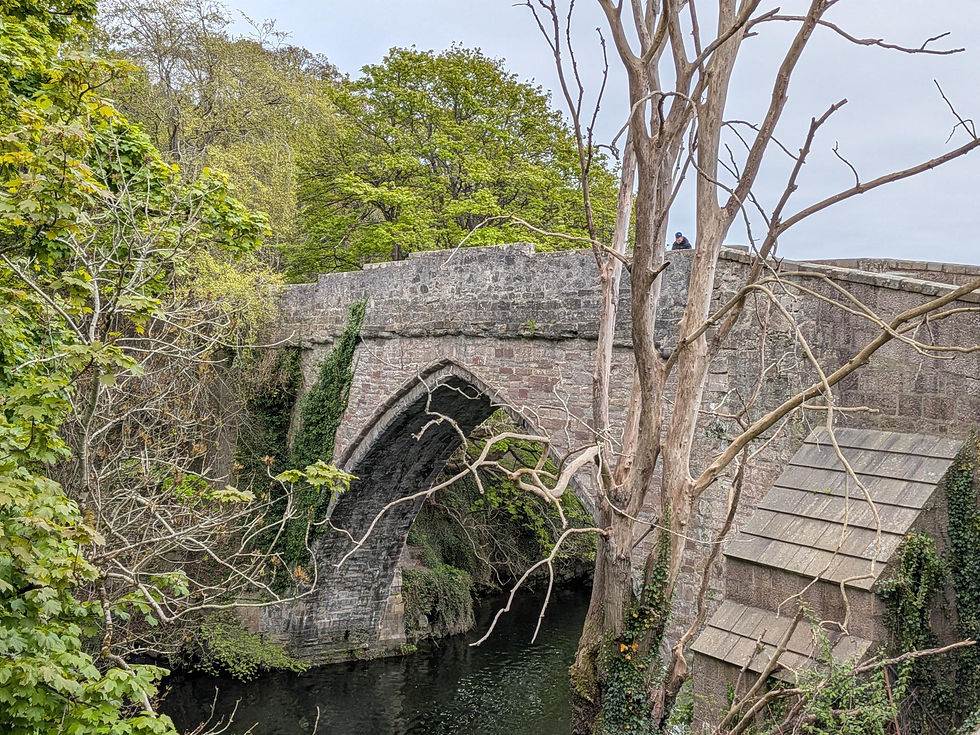
The perfect ending: a single-arch medieval bridge over the River Don, quietly beautiful and just the right amount of dramatic.
A surprisingly perfect Aberdeen stay
By the end of it all, we found ourselves properly won over by Aberdeen.
It doesn’t shout for attention, but it offers so much: great food, real history, walkable routes and unexpected moments — from ships gliding past your dinner table to discovering that your breakfast roll was once designed for life at sea.
And for cruise passengers stopping here? Genuinely — there’s more than enough to make a visit feel worthwhile and interesting.
Aberdeen might not be an obvious choice. But that, as it turns out, is very much part of its charm.
We were gifted the subscription to GPSmyCity, but all views are our own.


Comments